Typically I am pragmatic with my wont of helping others: Consider the ethics of the situation, don't put myself in danger, or bite off more than I can chew. These are not unreasonable things. There are, however, situations where pragmatism takes a back-seat.. or does it? The all-important question of "what should I do?"
Returning from my apartment's main office, having searched in vain for a package that ought to have arrived, a car pulled up beside me slowly.
"Excuse me," came a woman's voice; thinking she was looking for directions, I stopped. Then came, "I need someone's help with getting my laundry, and am willing to pay $20.00."
My heart stopped. Visions came to me as a kid saying "Don't talk to strangers in strange cars," like it was supposed to mean something to me as an adult. She was in no position to hurt or kidnap me, and obviously I would not let her if she was. The following was not conducive to my heart jumpstarting:
"I am a nurse, and just got out of the hospital. I was sick, but I'm not.. positive, anymore," she nodded knowingly, as if I already knew what she was insinuating--which I did, how could I not in these times?
She continued, "I'm in my 60's, and I have trouble breathing climbing stairs. My laundry's in sealed green trash bags. I just need someone to grab it and get it into my car, so I can drop it off somewhere to be cleaned."
Uneasily, I answered, "I can help, but I have to get my mask--"
"--Oh, I have one here. It has never been used," the woman said as she grabbed the mask dangling from her rear-view mirror. She picked another one out of her passenger seat. "I have a couple unused ones."
I shook my head with a low "nuh-uh." "I need mine," I answered, trying not to sound suspicious and afraid--but, as any wise person could tell you, the more you try to play something off, the more you end up coming off as the thing you wish to nullify. Case in point.
"I live just around the corner of this building, let me go in and get my mask," I said. "You can just pull up here." She thanked me and pulled up as indicated. I was passing by a side door to my building and thought Oh heck, I can just go in this way, but this must have made me look worse. You will see what I mean..
Heading inside, I asked my boyfriend Tim if I could use one of his masks and told him what transpired. He was very suspicious--and afraid, as he had a right to be: He is high-risk due to his asthma. In my head, I was rapid-firing a plan of action: Get this woman her laundry, dispose of the mask and wash my hands promptly.. the $20 could matter less, as long as I could keep Tim safe.. Yet the worried look on his face made me feel utterly stupid.
On the one hand, I earnestly wanted to help this woman; on the other, I was risking my loved one's health. I caught what I can only say is a glimpse of the stressful, incredibly difficult dilemma that medical personnel, supermarket workers and mail carriers (just to name a few) must have when they need to choose between keeping their jobs (and their loved ones fed, housed and healthy), even if that means they have to quarantine themselves away later.. or not work and be forced to potentially run out of income, having to fight with unemployment for their benefits.
"..Okay, I'll just tell her that I can't risk your health," I said to him, heading out the door. I halted for a moment before heading out of the building, just wondering if I was still doing the 'right thing.' Maybe this woman did not have anyone else who desired to help; maybe she exhausted her efforts on other passers-by. She was willing to approach a complete stranger to handle her laundry, and pay them.. It all felt so wrong. I headed out the door, preparing for her to be disappointed..
..but she was gone. I took too long; probably thinks I ditched her.. sonnuvabitch.. I was angry at myself, at my lack of better judgement; my lack of wisdom, even though it's impossible to gain wisdom if one does not experience things. Full disclaimer: I am not fair to myself, often. This is a bad habit I am trying to break and, as all bad habits go, it's hard.
I came back inside, annoyed, and sat down to writing this.
Less than a month ago, I wrote about how I feared I was Othering based on seeing folks out in public wearing masks. (This was written somewhere else entirely; this was also long before the CDC advised masks worn by everyone rather than just those who feel sick.) Othering is when you view someone/another group of people as fundamentally different from yourself, in essence vilifying them based on factors you don't understand (whether you meant to or not; e.g. class, gender, skin color).
So was I Othering this woman? Or was I just looking out for myself and--especially--for Tim? Was I being self-serving or pragmatic?
I will never know for sure if she really needed someone's help or if she somehow had malicious intentions.. but, inversely, I will never know if I could have gotten me or Tim ill. "Better to be safe than sorry," go the most basic of wise words. One likes to imagine that they will know what to do in situations like these, but it is rare to execute the plan perfectly. Socially-speaking, we all learn on our feet; we are all actors. We do not always do or say the best things in the worst scenarios, but most of us try..
..What would you do?
Tuesday, May 5, 2020

Wednesday, April 29, 2020
"Essential" and Examples of Classism
Early March was the starting point for many of us, as far as quarantine goes. Many of us were ordered to work from home until further notice; many of us still had to venture out to work, as supermarket and pharmacy workers, small-businesses who could not afford to close, mail carriers, doctors, nurses, geriatric care-givers; Door Dash, InstaCart, Amazon.. the list goes on.
In Massachusetts (which my observations take place) on March 23rd, Gov. Charlie Baker's administration put out an order regarding gatherings and defined "essential services." You can read it here, but to give you an idea, the table of contents includes:
Health Care/Public Health/Human Services
Law Enforcement, Public Safety, First Responders
Food and Agriculture
Energy
Water and Wastewater
Transportation and Logistics
Public Works & Infrastructure Support Services
Communications and Information Technology
Other Community-, Education-, or Government-Based Operations and Essential Functions
Critical Manufacturing
A fairly extensive list already--and the details therein these contents only makes them broader.
Was it designed to be broad? Of course. However, I know first-hand that some people did not realize they were considered "essential:" I worked for a billing and financing company that processed purchase orders and vendor invoices for sales associates. The associates were not selling T-shirts, coozies and tote bags lately, however--they were selling hand sanitizer, face masks, head coverings, gloves.. Anything that could contribute to public health safety equipment demand. Suddenly, I was "essential."
[I say "was" because I got terminated earlier this month.. and by "terminated" I mean laid off, without much hope of return, due to COVID-19.]
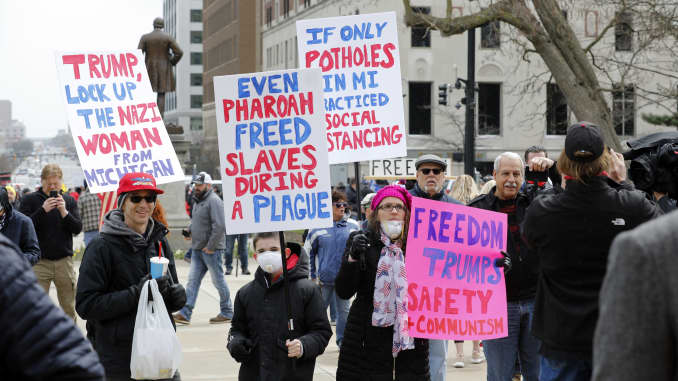
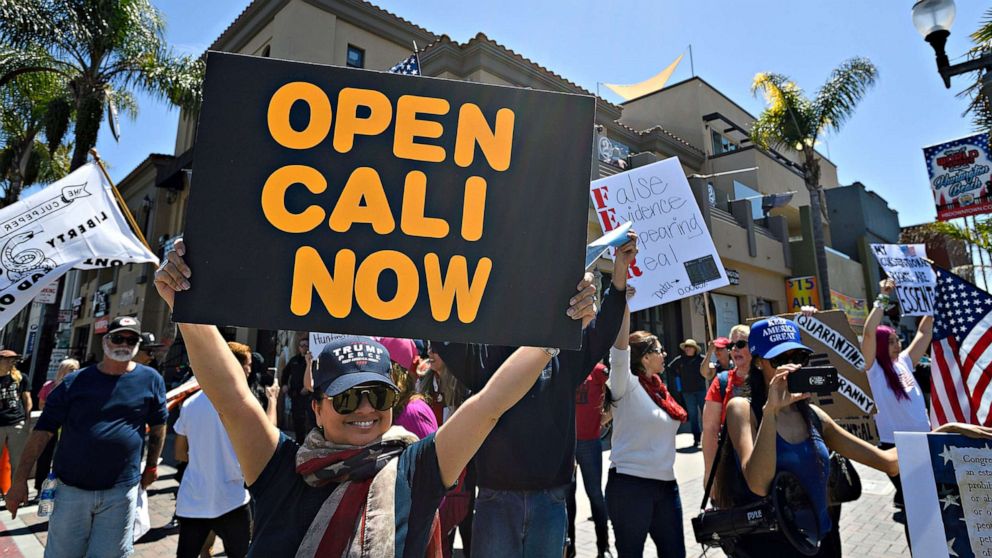
Getting back to the realization of what "essential" suddenly meant for us, allow me to now launch into the unsurprising (but still maddening) reality-laid-bare: Some of us thought we were above others all along. Put another way: Open-air classism. You have surely seen examples of this: Anti-quarantine protesters. None of the following images are mine, and can be easily Googled (sources cited in captions):
"Freedom trumps safety and communism?"
"Isolation of the healthy is tyranny?"
..."I want a haircut?"..
These statements are ignorant at best; classist at worst.
Those of us who are fortunate to still have employment, but are not considered essential (or possibly a health risk, such is the case with someone I know), may be on paid leave right now. Those of us who are able to work from home will at least still have an income, but nowhere to go with non-essential businesses being closed (e.g., salons/beauty parlors, dine-in restaurants, theaters). Even if one is essential and physically heading into work, there is no guarantee that one is being paid more for their services.
Understandably, the topic of income inequality is a complex one, as classism rewards those with the unwritten code of conduct, inherent wealth and high-brow tastes--in short, cultural capital--the tangible and symbolic safety nets and status; upper-classmanship. Maybe in another entry I'll lapse into Weberian and Marxist theories about how upper-class status is achieved.
Bearing this in mind, it's worth reminding that everyone is capable of classism. For the sake of this entry, it is the degree of separation from reality that matters here.
Many of us choose to cope with the lack of haircut through social media memes and TikToks, sometimes making light out of a dark situation; other times making satire out of such protesters as the above. The protester, however, is not placing themselves in a satirical or otherwise jesting position. Even in cases where these protesters are working-poor, those who "want their haircut," or think "isolation of the healthy is tyranny," are displaying that they think quarantine is for someone beneath them.
That, somehow, a haircut is more important to their immediate needs than the safety of the hair-dresser. This could be applied to other non-essential desires: "I want to go to the movies;" "I want to meet up with friends at the bar;" "I want to go to the mall."
All of which is saying: "I want you to submit to me, such as the way it always was."
"Return us to normal."
Here are some questions to ask one's self:
1.) Is it "tyrannical" or "communist" to want all people--including those who appear to believe they are better than others--to not fall ill, or pass it onto their loved ones? Loved ones who may be immunocompromised or have pre-existing conditions?
2.) To strongly advise hand-washing not just for this pandemic, but for generally-good hygienic practices that generally keep us safe?
3.) To keep non-essential business closed and people home so as to slow the spread of a virus we are still learning about every day?
..True, there are small businesses (especially minority-/women-owned) that are hurting. This is a cause for alarm, especially there was already discrimination against these and interesectional people (the history of our racial wealth gap comes to mind, but one recent example can be read about here). Let us imagine that some of these protesters had these small businesses in mind..
..Yes, we are in part flying by the seats of our collective pants to staunch the bleeding that the lack of reliable, trustworthy information is causing. However, ill-advised demanding of businesses large and small to be reopened is not going to help anyone overcome a pandemic. The "normal" these protesters sorely want is not--clearly never was--a healthy "normal."
More questions:
4.) What do we define as a baseline "normal?"
5.) Does this "normal" include treating customer service, retail and other "essential" service workers with disrespect or misdirected anger when something doesn't go your way? Does it include said-workers continuing to be underpaid and with fewer benefits? Does it include unquestioned service under the notion of "the customer's always right?"
6.) Does it include leaving in place the systemic problems that keep women-owned, minority-, even LGBTQ- and intersectional-owned businesses placed on lower, less-prioritize rungs in our competitive, hyper-capitalistic and upper-class affirmative markets?
In Massachusetts (which my observations take place) on March 23rd, Gov. Charlie Baker's administration put out an order regarding gatherings and defined "essential services." You can read it here, but to give you an idea, the table of contents includes:
Health Care/Public Health/Human Services
Law Enforcement, Public Safety, First Responders
Food and Agriculture
Energy
Water and Wastewater
Transportation and Logistics
Public Works & Infrastructure Support Services
Communications and Information Technology
Other Community-, Education-, or Government-Based Operations and Essential Functions
Critical Manufacturing
A fairly extensive list already--and the details therein these contents only makes them broader.
Was it designed to be broad? Of course. However, I know first-hand that some people did not realize they were considered "essential:" I worked for a billing and financing company that processed purchase orders and vendor invoices for sales associates. The associates were not selling T-shirts, coozies and tote bags lately, however--they were selling hand sanitizer, face masks, head coverings, gloves.. Anything that could contribute to public health safety equipment demand. Suddenly, I was "essential."
[I say "was" because I got terminated earlier this month.. and by "terminated" I mean laid off, without much hope of return, due to COVID-19.]
Getting back to the realization of what "essential" suddenly meant for us, allow me to now launch into the unsurprising (but still maddening) reality-laid-bare: Some of us thought we were above others all along. Put another way: Open-air classism. You have surely seen examples of this: Anti-quarantine protesters. None of the following images are mine, and can be easily Googled (sources cited in captions):
 |
| Source: CNBC.com |
/cdn.vox-cdn.com/uploads/chorus_image/image/66680736/1210379392.jpg.0.jpg) |
| Source: Vox.com |
 |
| Source: The Milwaukee Independent |
 |
| Source: ABC News |
 |
| Source: MSN.com |
"Freedom trumps safety and communism?"
"Isolation of the healthy is tyranny?"
..."I want a haircut?"..
These statements are ignorant at best; classist at worst.
Those of us who are fortunate to still have employment, but are not considered essential (or possibly a health risk, such is the case with someone I know), may be on paid leave right now. Those of us who are able to work from home will at least still have an income, but nowhere to go with non-essential businesses being closed (e.g., salons/beauty parlors, dine-in restaurants, theaters). Even if one is essential and physically heading into work, there is no guarantee that one is being paid more for their services.
Understandably, the topic of income inequality is a complex one, as classism rewards those with the unwritten code of conduct, inherent wealth and high-brow tastes--in short, cultural capital--the tangible and symbolic safety nets and status; upper-classmanship. Maybe in another entry I'll lapse into Weberian and Marxist theories about how upper-class status is achieved.
Bearing this in mind, it's worth reminding that everyone is capable of classism. For the sake of this entry, it is the degree of separation from reality that matters here.
Many of us choose to cope with the lack of haircut through social media memes and TikToks, sometimes making light out of a dark situation; other times making satire out of such protesters as the above. The protester, however, is not placing themselves in a satirical or otherwise jesting position. Even in cases where these protesters are working-poor, those who "want their haircut," or think "isolation of the healthy is tyranny," are displaying that they think quarantine is for someone beneath them.
That, somehow, a haircut is more important to their immediate needs than the safety of the hair-dresser. This could be applied to other non-essential desires: "I want to go to the movies;" "I want to meet up with friends at the bar;" "I want to go to the mall."
All of which is saying: "I want you to submit to me, such as the way it always was."
"Return us to normal."
Here are some questions to ask one's self:
1.) Is it "tyrannical" or "communist" to want all people--including those who appear to believe they are better than others--to not fall ill, or pass it onto their loved ones? Loved ones who may be immunocompromised or have pre-existing conditions?
2.) To strongly advise hand-washing not just for this pandemic, but for generally-good hygienic practices that generally keep us safe?
3.) To keep non-essential business closed and people home so as to slow the spread of a virus we are still learning about every day?
..True, there are small businesses (especially minority-/women-owned) that are hurting. This is a cause for alarm, especially there was already discrimination against these and interesectional people (the history of our racial wealth gap comes to mind, but one recent example can be read about here). Let us imagine that some of these protesters had these small businesses in mind..
..Yes, we are in part flying by the seats of our collective pants to staunch the bleeding that the lack of reliable, trustworthy information is causing. However, ill-advised demanding of businesses large and small to be reopened is not going to help anyone overcome a pandemic. The "normal" these protesters sorely want is not--clearly never was--a healthy "normal."
More questions:
4.) What do we define as a baseline "normal?"
5.) Does this "normal" include treating customer service, retail and other "essential" service workers with disrespect or misdirected anger when something doesn't go your way? Does it include said-workers continuing to be underpaid and with fewer benefits? Does it include unquestioned service under the notion of "the customer's always right?"
6.) Does it include leaving in place the systemic problems that keep women-owned, minority-, even LGBTQ- and intersectional-owned businesses placed on lower, less-prioritize rungs in our competitive, hyper-capitalistic and upper-class affirmative markets?
Subscribe to:
Posts (Atom)